Man, I wish I had an easier way to share my reading lists.
I realize that it has been a while since I last updated my little "about me" blurb. No, I am not still reading the most recent (English-language) edition of Diogenes. But, since I do read numerous periodicals (bimonthly and quarterly publishing) and weeklies (the Economist, for one) it is pretty onerous to try to update my reading status each time.
I think that for the next little while, I will try to find a tool that will help me to easily share what I am reading.
Showing posts with label rambling. Show all posts
Showing posts with label rambling. Show all posts
Monday, August 23, 2010


Monday, May 03, 2010
Team Awesome's Newest Member!
-Or-
Crate Training Cesar's Way Is Not as Easy as Cesar Makes It Look.
Yes, this is a post about a puppy. Since he is set to take up quite a lot of my time over the next few months, to say nothing of the years of friendship, I think that it is impossible to not write about him. His call name is Bifteck, and pictures of him will doubtless follow. The registered name has not been decided, since She-Who-Must-Be-Obeyed conveniently left town for the last few days.
That said, this post is about some of the advice out there about dogs and puppy training. I read the Dog Whisperer's book about puppies a couple of days ago, and I was really sold on the crate training idea. My first disclaimer: I in no way have any pretensions of knowing how to raise a dog better than Cesar. However, I'd like to talk about how difficult some of his "easy steps" are to follow.
The only problem seems to be making the puppy see it that way too. The Dog Whisperer has this whole "calm assertive energy" thing throughout the book. I guess that it really underlines how much of an art his techniques are, as opposed to a science. Back to the crate training: the book explains that puppies should be introduced to crates at a young age, so that they will have a "den"- a place to be calm and relaxed. The added benefit that really impressed me is that it will be easier to house-train the dog, because a dog will do everything that it can to avoid being on or near its own waste. In an ideal situation, that means holding their bladder until they go outside.
So how does the Dog Whisperer recommend you go about introducing your dog to the crate? There are a couple of anecdotes about new owners who follow [the Dog Whisperer's] advice by "bribing" and "encouraging" the dog to enter and relax (and remain) in the crate by using their "calm assertive" energies.
I've got to get me some of that calm-assertive west-coast juice, because getting Bifteck (the puppy) to stay in his crate has proven difficult, if not impossible. The best that I seem to be able to do is to open all of the doors, and let him wander in and out of the crate. If I close the doors, he just freaks out on me. Of course, the book recommends that you "never try to crate an excited dog". But, what do you do when a "calm relaxed" dog becomes excited when he goes near the crate?
So far, my only hope is that Bifteck will start to relax in the crate. So I'm following the program of offering bribes and praise when he enters and settles into the crate. Maybe by the time he is 12 weeks old or so, he'll be more comfortable in there, and I can start to take down the maze of baby gates that my apartment has become.
-Or-
Crate Training Cesar's Way Is Not as Easy as Cesar Makes It Look.
Yes, this is a post about a puppy. Since he is set to take up quite a lot of my time over the next few months, to say nothing of the years of friendship, I think that it is impossible to not write about him. His call name is Bifteck, and pictures of him will doubtless follow. The registered name has not been decided, since She-Who-Must-Be-Obeyed conveniently left town for the last few days.
That said, this post is about some of the advice out there about dogs and puppy training. I read the Dog Whisperer's book about puppies a couple of days ago, and I was really sold on the crate training idea. My first disclaimer: I in no way have any pretensions of knowing how to raise a dog better than Cesar. However, I'd like to talk about how difficult some of his "easy steps" are to follow.
The only problem seems to be making the puppy see it that way too. The Dog Whisperer has this whole "calm assertive energy" thing throughout the book. I guess that it really underlines how much of an art his techniques are, as opposed to a science. Back to the crate training: the book explains that puppies should be introduced to crates at a young age, so that they will have a "den"- a place to be calm and relaxed. The added benefit that really impressed me is that it will be easier to house-train the dog, because a dog will do everything that it can to avoid being on or near its own waste. In an ideal situation, that means holding their bladder until they go outside.
So how does the Dog Whisperer recommend you go about introducing your dog to the crate? There are a couple of anecdotes about new owners who follow [the Dog Whisperer's] advice by "bribing" and "encouraging" the dog to enter and relax (and remain) in the crate by using their "calm assertive" energies.
I've got to get me some of that calm-assertive west-coast juice, because getting Bifteck (the puppy) to stay in his crate has proven difficult, if not impossible. The best that I seem to be able to do is to open all of the doors, and let him wander in and out of the crate. If I close the doors, he just freaks out on me. Of course, the book recommends that you "never try to crate an excited dog". But, what do you do when a "calm relaxed" dog becomes excited when he goes near the crate?
So far, my only hope is that Bifteck will start to relax in the crate. So I'm following the program of offering bribes and praise when he enters and settles into the crate. Maybe by the time he is 12 weeks old or so, he'll be more comfortable in there, and I can start to take down the maze of baby gates that my apartment has become.
Sunday, March 30, 2008
Evil Dead: the Musical
Some rumors have been circulating for the last week-or-so, and I think that it is time an annoucement was made to clear things up.
It's official: Team Awesome is going to see "Evil Dead: The Musical".

I'm stoked about this show, because the movie franchise is one of my favourites. I'll admit that when I first heard about the show, I was a little concerned. However, after some consideration I became baffled by my initial response. The movies basically have one set, the Cabin, where all of the action takes place. Talk about ideal for moving it onto the stage.
Then I did a little research, and came across this little quote in the FAQ section on the show's website: "...we cannot guarantee you won’t get blood on you (so perhaps you should save the white cashmere sweater for another outing)."
...
Cannot guarantee that you won't get blood on you?
Intrigued, I read on: "What do I need to wear in the Splatter zone? Can I bring a raincoat/umbrella?"
Hells yeah. Basically, I am expecting this show to be like a trip to SeaWorld, but with blood. A whole ton of it.
Unfortunately, SheWhoMustBeObeyed forbade the purchase of tickets in the splatter section. Something about 'not wanting to be covered in blood when we go out for dinner that evening.'
Obviously I am considering a renegotiation of SWMBO's position on Team Awesome.
Luckily, SheWhoMustBeObeyed does not know that:
the spraying, splashing, pouring, and splattering of blood into the audience is not an exact science, so if you are sitting in the first few rows, it is entirely possible you will get some blood on you.
I'm hoping that our tickets, which are in 221-224, are still close enough to get some action.
If the show rocks (I think it will), Team Awesome will be returning at a later date. In the splatter zone.
Since we are not going until April 18th; if anyone has a review or any comments that they would like to share, feel free to let me know what you thought of the production.
Some rumors have been circulating for the last week-or-so, and I think that it is time an annoucement was made to clear things up.
It's official: Team Awesome is going to see "Evil Dead: The Musical".
I'm stoked about this show, because the movie franchise is one of my favourites. I'll admit that when I first heard about the show, I was a little concerned. However, after some consideration I became baffled by my initial response. The movies basically have one set, the Cabin, where all of the action takes place. Talk about ideal for moving it onto the stage.
Then I did a little research, and came across this little quote in the FAQ section on the show's website: "...we cannot guarantee you won’t get blood on you (so perhaps you should save the white cashmere sweater for another outing)."
...
Cannot guarantee that you won't get blood on you?
Intrigued, I read on: "What do I need to wear in the Splatter zone? Can I bring a raincoat/umbrella?"
Hells yeah. Basically, I am expecting this show to be like a trip to SeaWorld, but with blood. A whole ton of it.
Unfortunately, SheWhoMustBeObeyed forbade the purchase of tickets in the splatter section. Something about 'not wanting to be covered in blood when we go out for dinner that evening.'
Obviously I am considering a renegotiation of SWMBO's position on Team Awesome.
Luckily, SheWhoMustBeObeyed does not know that:
the spraying, splashing, pouring, and splattering of blood into the audience is not an exact science, so if you are sitting in the first few rows, it is entirely possible you will get some blood on you.
I'm hoping that our tickets, which are in 221-224, are still close enough to get some action.
If the show rocks (I think it will), Team Awesome will be returning at a later date. In the splatter zone.
Since we are not going until April 18th; if anyone has a review or any comments that they would like to share, feel free to let me know what you thought of the production.
Monday, March 03, 2008
This week's LCBO gem.
Alright, I'll admit that I am a bit of a wine-o. I grew up in a household where wine accompanying a meal was chosen according to its characteristics and flavours. So, aside from being a wine-o, I am also a bit of a wine snob.
But, that does not mean that I believe that good wine is only found in the vintages section. In fact, I prefer to pick out bottles from the variety found in the aisles. Sometimes I will try out something cheap, sometimes it will be a bit expensive.
Admittedly, I tend to drift towards the cheaper bottles, as it is easier to buy 2 or 3 at a time, and not feel as though I am taking a dent out my budget. After being a student for so long, these considerations tend to come naturally.
So, I recently came across this little gem at the LCBO:

It's the 2007 "Astica" Sauvignon/Semillón bottled by Trapiche. The wine is described as a "remarkably fresh with soft tropical fruit flavours." Now, I am not so sure about the "tropical fruit" descriptor, since the dominant flavour seemed to be peach: a fruit local to the Niagara region.
Quibbles about the tropical-ness of the fruit flavour aside, the wine went really well with stuffed chicken breast, accompanied by rice and a creamy mushroom sauce. Although the recommended serving temperature is 10-16°C, I find that serving it in the 6-10° range compensates for the acidity that follows each sip.
The best part about this find: the price. At $8.10, it is a deal. The wine can be served casually, or you can also keep it around for special occasions. It’s probably best with chicken or white fish, but it is also pretty good along with nachos and mango salsa.
So: Peachy, cheap, and a little dry.
Details:
Trapiche (Argentina)
Sauvignon/Semillón
LCBO#: 359083
750 mL bottle
Price: $ 8.10
White wine, slight dryness with mild peach flavour
Alright, I'll admit that I am a bit of a wine-o. I grew up in a household where wine accompanying a meal was chosen according to its characteristics and flavours. So, aside from being a wine-o, I am also a bit of a wine snob.
But, that does not mean that I believe that good wine is only found in the vintages section. In fact, I prefer to pick out bottles from the variety found in the aisles. Sometimes I will try out something cheap, sometimes it will be a bit expensive.
Admittedly, I tend to drift towards the cheaper bottles, as it is easier to buy 2 or 3 at a time, and not feel as though I am taking a dent out my budget. After being a student for so long, these considerations tend to come naturally.
So, I recently came across this little gem at the LCBO:
It's the 2007 "Astica" Sauvignon/Semillón bottled by Trapiche. The wine is described as a "remarkably fresh with soft tropical fruit flavours." Now, I am not so sure about the "tropical fruit" descriptor, since the dominant flavour seemed to be peach: a fruit local to the Niagara region.
Quibbles about the tropical-ness of the fruit flavour aside, the wine went really well with stuffed chicken breast, accompanied by rice and a creamy mushroom sauce. Although the recommended serving temperature is 10-16°C, I find that serving it in the 6-10° range compensates for the acidity that follows each sip.
The best part about this find: the price. At $8.10, it is a deal. The wine can be served casually, or you can also keep it around for special occasions. It’s probably best with chicken or white fish, but it is also pretty good along with nachos and mango salsa.
So: Peachy, cheap, and a little dry.
Details:
Trapiche (Argentina)
Sauvignon/Semillón
LCBO#: 359083
750 mL bottle
Price: $ 8.10
White wine, slight dryness with mild peach flavour
Monday, November 20, 2006
The origins of the mouth-breather.

Alright. One post on how much I detest mouthbreathing was just not enough for me. So, herein I am going to try to investigate the historical status of the mouthbreather. I just want to understand where we went wrong.
Wikipedia has a useful entry on mouthbreathing, covering both the medical definition and the common impression of the behaviour. Note that I am obviously not the only one on this most-just crusade. Actually, I have found at least one supporter on the net.
However, wikipedia does not give me any information on when the term first entered use. So, I checked out dictionary.com…that veritable treasure-trove of idiomatic knowledge…and I got bupkis. Nadda. There was one definition, and it was simply concerning the mechanical/medical status of mouth breathing. There was nothing on the social appearances, or the negative impact of the behaviour.
I started to suspect a conspiracy. Could the mouthbreathers have allies high-up enough that they are preventing common-knowledge from being recorded? Could The Man be a mouth-breather?
Worried, I decided to re-start my search with a resource that features the “common” usages of terms. That’s right- the Double-Tongued Dictionary. I was delighted to find that the definition for “mouth-breather” was (rightly so):
mouth-breather n. a stupid person; a moron, dolt, imbecile. Related: English, Derogatory, Slang
What is even more useful about the DTD is the fact that the site provides a list of citations supporting their definition. This way, one can get a sense of when the term started to take on its meaning. In this case, the earliest citation of “mouth-breather” used in the manner described by the definition (after all, what is the definition of a word other than how it is used in a phrase?) was from 1944.
I was a little doubtful of this date, so I decided to check if it appeared at all earlier. Much earlier. I decided to search for “mouth breather” on EEBO. And once again, I got bupkis.
So it seems that the pathology of mouth-breathing was not discovered (or, dare I say it: created) until the current century. There was an etymology discussion on washingtonmonthly.com surrounding where the term may have originated. The earliest that this author could find of the use of the term was with regards to the physical effects of mouth breathing on hearing.
So I tried using FindForward’s “early century” search counter. The results gathered by the search for “mouth breather” suggest that the use of the term peaked during the 1940s. However, since this search does not allow me to actually see the data gathered, I can not say for sure if the results are relevant to my search.
The “later century” search saw some interesting variation in the use of the term (peaking in the early 80s), but once again, since it does not actually allow you to access the data, I can not determine the relevance. However, what is interesting is if you compare these results to a search of the term “mouthbreather” (one-word). The results peak around the same years. Once again, though, the fact that I cannot examine the data for myself makes the results dubious.

Alright. One post on how much I detest mouthbreathing was just not enough for me. So, herein I am going to try to investigate the historical status of the mouthbreather. I just want to understand where we went wrong.
Wikipedia has a useful entry on mouthbreathing, covering both the medical definition and the common impression of the behaviour. Note that I am obviously not the only one on this most-just crusade. Actually, I have found at least one supporter on the net.
However, wikipedia does not give me any information on when the term first entered use. So, I checked out dictionary.com…that veritable treasure-trove of idiomatic knowledge…and I got bupkis. Nadda. There was one definition, and it was simply concerning the mechanical/medical status of mouth breathing. There was nothing on the social appearances, or the negative impact of the behaviour.
I started to suspect a conspiracy. Could the mouthbreathers have allies high-up enough that they are preventing common-knowledge from being recorded? Could The Man be a mouth-breather?
Worried, I decided to re-start my search with a resource that features the “common” usages of terms. That’s right- the Double-Tongued Dictionary. I was delighted to find that the definition for “mouth-breather” was (rightly so):
mouth-breather n. a stupid person; a moron, dolt, imbecile. Related: English, Derogatory, Slang
What is even more useful about the DTD is the fact that the site provides a list of citations supporting their definition. This way, one can get a sense of when the term started to take on its meaning. In this case, the earliest citation of “mouth-breather” used in the manner described by the definition (after all, what is the definition of a word other than how it is used in a phrase?) was from 1944.
I was a little doubtful of this date, so I decided to check if it appeared at all earlier. Much earlier. I decided to search for “mouth breather” on EEBO. And once again, I got bupkis.
So it seems that the pathology of mouth-breathing was not discovered (or, dare I say it: created) until the current century. There was an etymology discussion on washingtonmonthly.com surrounding where the term may have originated. The earliest that this author could find of the use of the term was with regards to the physical effects of mouth breathing on hearing.
So I tried using FindForward’s “early century” search counter. The results gathered by the search for “mouth breather” suggest that the use of the term peaked during the 1940s. However, since this search does not allow me to actually see the data gathered, I can not say for sure if the results are relevant to my search.
The “later century” search saw some interesting variation in the use of the term (peaking in the early 80s), but once again, since it does not actually allow you to access the data, I can not determine the relevance. However, what is interesting is if you compare these results to a search of the term “mouthbreather” (one-word). The results peak around the same years. Once again, though, the fact that I cannot examine the data for myself makes the results dubious.
Friday, November 17, 2006
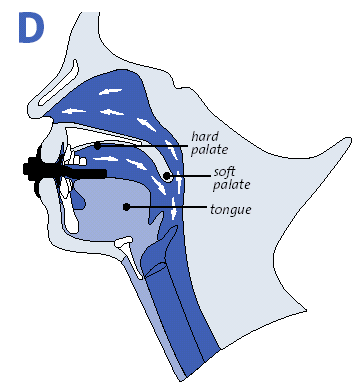

I hate mouthbreathers.
I know that this is definately not a post about using digital sources to do historical research, but I really have to say something. While doing some crowd wathcing over lunch this afternoon, I must have counted something like 20 mouthbreathers. Some were even
In the new regime, I am going to put a public tax on mouth-breathers.
Seriously. I think that there are one or two other things that one could do to successfully tell the world that they are barely thinking. Now, before writing this off as just another diatribe- which, admittedly it is- just stop to think about it. Have you not ever seen someone walking on campus with their mouth half open? Haven't you also noticed the fixed-forward stare of these people? Honestly, it looks as though they are asleep on two feet. What's worse, is the dull, glazed-over expression that dominates the face. Why don't these people take a look in the mirror? Moreover: the sound. I swear that whenever I go to a movie theatre, in that moment when the lights go down and the audience quietly awaits the film to start (or, properly, the commercials), I can always hear a cacophany of mouth breathing. That's right. It's this not-quite-a-snore-but-damn-louder-than-NORMAL-breathing sound.
Well, it could just be that they are living down a long evening, or they are suffering through a long day, and they really are starting to fall asleep on their feet. But I doubt that that is always the case. This seems to me to be an abnormality that is fostered by our health-care-centric, lazy, sedentary lifestyle. If people were more active, breathing through their noses would become normal. Yes, it is true that you can draw more air through your mouth. So when you are exercising it makes sense to inhale through the mouth. However, it is also very effective to exhale slowly. Come on, everyone has done those calming exercises where they are told to "breathe in 1-2-3, hold, and exhale 1-2-3-4".
This is not just some yoga-new-age-mumbo-voodoo. There is a physiological rationale here. When you exhale too quickly, you throw off the CO2 balance in your blood. This is usually referred to as hyperventillation. Not healthy, to say the least. When your CO2 balance is off, your body stops functioning properly. This results in the fatigued I'm-so-tired-that-can't-even-find-the-strength-to-close-my-mouth look.
Aside from leaving the body in a panic-response mode, imbalances in blood pH can lead to immune deficiencies, and increase sensitivities to allergens and other air-borne pollutants. There are also several other points about the detriments of mouth-breathing, but the last one that I will bring up is that mouth breathers are obviously bad kissers.
Take running, for instance. Hmmm....now that I think of it, running may be a bad example of nose-breathing vs. mouth breathing since most people do not have to worry about breathing rythm. Also, I think that the general consensus among runners is that whatever works is good for you.
But that doesn't help to prove that nose breathing is better. Swimming: there's a sport where your breathing rythm affects performance. Try swimming while exhaling through the mouth, and then through the nose. You should find that you need to take fewer breaths/length when exhaling through the nose. Inhaling through the nose is a bit more difficult due to (proper) head position, so a combination of mouth-inhaling and nose-exhaling is probably best.
My bottom line here is that mouth breathing is just ugly, aside from being un-healthy. Especially when not exercising. Now, as a nose breather I know that nose-breathers can be equally loud. I am pretty sure that everyone has had that experience where they go from walking outdoors and sit down inside and then their nose starts running. If you don't have a bunch of tissues on you, you end up making sniffing sounds every couple of minutes. Believe it or not, but I find that this sound is much more tolerable than the slightly-audible grating of a mouth breather.
So, to all of the mouth breathers out there: there is hope for you. Admit you have a problem, and seek some rehabilitation.
Monday, October 30, 2006
I (heart) Python
So I have finally decided to sit down and try to learn some of this programming mumbo-jumbo. After glancing over a couple of the beginner's guides, I have settled on Guido Van Rossum's Python Tutorial. I find that his guide is much clearer on indenting than some of the others, but the one thing that I would really appreciate is a syntax guide. Even if it was just a list of the most basic functions would be helpful, as it would spare me from constantly growling at the computer.
So I have finally decided to sit down and try to learn some of this programming mumbo-jumbo. After glancing over a couple of the beginner's guides, I have settled on Guido Van Rossum's Python Tutorial. I find that his guide is much clearer on indenting than some of the others, but the one thing that I would really appreciate is a syntax guide. Even if it was just a list of the most basic functions would be helpful, as it would spare me from constantly growling at the computer.
Wednesday, October 25, 2006
Context-hunting computers?
During an in-class discussion the other day, a question was posited about how a computer program could be made to search a digitized text for its context (or was it subtext?)
This got me thinking about a tool that can be easily accessed on the internet: the linguist's search engine. Basically, it is a program that can break down a phrase/sentence into its syntactic parts. So, if you enter the statement: "The Chinese community was blamed for the 2003 SARS pandemic", the program will identify that the subject of the statment is the "chinese community".
What I think would be pretty awesome is a tool that can take a search query (like the one stated above) and first identify the syntactic role of the various word-strings. Following this, it could create an ad hoc storage base not only of the separate word-strings, but also for word-strings semantically related (re:synonyms (probably the first three entries of an on-line dictionary)) to those data pieces. This way, you could have a program that can perform a broad non-specific search for a particular phrase.
I had always wondered if there was a way to graphically represent people's reactions following a particular event in the news. With a program like this, I believe that it would be possible to find out how many people thought, e.g., that the Michigan Militia (re: T. McVeigh) was responsible for the attacks of Sep 11/2001, before al-qaeda released a video taking responsability.
I'm not too sure how to make a program like this work, or even if it is feasible. BUT, in theory it seems sort of cool.
Any thoughts?
During an in-class discussion the other day, a question was posited about how a computer program could be made to search a digitized text for its context (or was it subtext?)
This got me thinking about a tool that can be easily accessed on the internet: the linguist's search engine. Basically, it is a program that can break down a phrase/sentence into its syntactic parts. So, if you enter the statement: "The Chinese community was blamed for the 2003 SARS pandemic", the program will identify that the subject of the statment is the "chinese community".
What I think would be pretty awesome is a tool that can take a search query (like the one stated above) and first identify the syntactic role of the various word-strings. Following this, it could create an ad hoc storage base not only of the separate word-strings, but also for word-strings semantically related (re:synonyms (probably the first three entries of an on-line dictionary)) to those data pieces. This way, you could have a program that can perform a broad non-specific search for a particular phrase.
I had always wondered if there was a way to graphically represent people's reactions following a particular event in the news. With a program like this, I believe that it would be possible to find out how many people thought, e.g., that the Michigan Militia (re: T. McVeigh) was responsible for the attacks of Sep 11/2001, before al-qaeda released a video taking responsability.
I'm not too sure how to make a program like this work, or even if it is feasible. BUT, in theory it seems sort of cool.
Any thoughts?
Thursday, September 14, 2006
Phlogiston on the Web
So continuing the elaboration/rant about the phlogiston theory, I suppose that I should explain it. Rather than pull out references to the particular print literature that discusses the history of the theory, I am going to try to use this 'intra-web' thingy to assemble useful information about the history of the Phlogiston theory.
After entering "Phlogiston:" as my basic search term on Google.com, the top results were (in descending order):
Wikipedia
Infoplease
JimLoy.com (a personal webpage)
A transcription of Joseph Priestly's 1796 Essay: "Considerations on the Doctrine of Phlogiston and the Decomposition of Water" (transcription by C. Giunta, Dept. of Chemistry, LeMoyne College).
Each of these websites is interesting, and (hopefully soon) I will share some of my thoughts on how useful they are to a historian.
So continuing the elaboration/rant about the phlogiston theory, I suppose that I should explain it. Rather than pull out references to the particular print literature that discusses the history of the theory, I am going to try to use this 'intra-web' thingy to assemble useful information about the history of the Phlogiston theory.
After entering "Phlogiston:" as my basic search term on Google.com, the top results were (in descending order):
Wikipedia
Infoplease
JimLoy.com (a personal webpage)
A transcription of Joseph Priestly's 1796 Essay: "Considerations on the Doctrine of Phlogiston and the Decomposition of Water" (transcription by C. Giunta, Dept. of Chemistry, LeMoyne College).
Each of these websites is interesting, and (hopefully soon) I will share some of my thoughts on how useful they are to a historian.
Subscribe to:
Posts (Atom)