Thursday, June 26, 2008

The Great Beef Soup Challenge Commences!


I was in the canned soup aisle of my local grocery store last night when I was hit by a sudden urge for canned beef soup. It was not one of those "I need beef soup now" urges, but one of those "you know what would be really good for lunch tomorrow? Beef Soup" urges. There was just one problem: choice.

Rather than risk getting "the bad" canned beef soup from the large selection, I decided that I would spread myself across the board: I bought one of each and will spend the next week eating beef soup for lunch.

I haven't eaten this way since I was an undergrad, so there is an off-chance that I will go insane by the end of next week. Now, this may sound strange, but that result will be a little comforting as it will help to explain those "crazy undergrad" years. Kind of like the discovery of the heavy amount of lead in ancient Rome's water pipes...


First up: Campbell's Healthy Request Vegetable Beef with Barley.

I decided to start with the "Healthy Request" selection because I guessed that "less sodium" and "healthy request" would also equal "no taste" and "leaves you strangely hungry." It turns out that I was right on both accounts. The soup has the thickness and texture of a good beef soup (chewy-but-not-tough meat and squishy vegetables), but none of the flavour. Aside from the faint taste of beef, I could have been eating any kind of soup at all. Very disappointing.

Wednesday, June 25, 2008

Bad MDG

I am really pissed-off by MDG Computers right now. I took in my less-than-one year old PC, as well as SheWhoMustBeObeyed's (SWMBO's) PC to get serviced last week. My unit required the mother-board to be replaced because of a faulty LAN card...that was alright because it was still under warranty. SWMBO's PC, it turned out, was having come problems because its version of Windows (XP SP2) was corrupt. Whatever, the PC is 5 years old so this sort of thing is expected. There was also a recommendation to upgrade the RAM to 1 GB (to which I agreed).

When it came time to pick-up the units, I "discovered" the following facts:

1) My antivirus software was no longer functioning, my start-up group of programs had been modified, and my version of windows required activation;

2) And, (this is the important complaint) SWMBO's harddrive was completely wiped because Windows had to be re-installed.

When I called to ask (re: yell until I was satisfied that the moron on the other end was just as angry with me as I was with him) about what was going on, I was given some lame-ass explanantion that:

"It is MDG policy to ask about whether or not a back-up should be made, at extra cost ($X), in the event that Windows requires re-installation."

Since no request was made, a back-up of the (SWMBO's) hard drive was not produced. Well, well, well. The big problem with that statement is that I was never offered a "back-up", and I was never told that this service would result in SWMBO's hard-drive being purged. Of course I would have wanted a backup if I was told that the hard-drive was going to be wiped! And, there was a big "silence" at the other end when I asked why my antivirus and startup settings were modified (re: broken).

Now, I have been pretty happy with my MDG computer and I am NOT recommending against buying one. I am proud of the fact that the computers are built and sold by techs and salespeople here in Canada. However, if you are going to get your computer serviced, stay as far away from the Etobicoke store as you can get. They may have gotten my $300, but they will never get me to return.

Monday, June 23, 2008

I am going to bet it was goose poo.

The National Post recently published a warning issued by the Toronto Police Department concerning a spate of dog-poisoning in High Park. I run through the park 3-4 times a week, and my money is on goose-poo being the culprit. At this time of year, there are so many geese wandering the park and the area around Grenadier Pond that the path is, in some places, covered with a slick green slime.

I feel really bad for the owners of the dogs, since it is impossible to watch your dog for every minute of the walk. It is especially impossible- and, I would argue cruel- to keep them from sniffing (and thereby licking) at the things that interest them. No I don't mean that dogs sniff by licking, instead, I am trying to say that if one is to prevent a dog from licking foreign objects/substances, one must prevent them from sniffing it since their tongue and nose will be equally close to the object of inquiry.

Here's to hoping that a pathologist or veterinarian figures out the vector for the poison. Once again, I am betting it is a massive bacterial infection caused by ingesting goose feces.

Update: According to this story the dogs have been poisoned in what appears to be a deliberate attack, against them and their owners. Personally, I don't buy the "person disgruntled against the off-leash areas" statement made by the police. However, I guess that I am not quite willing to accept that someone would be willing to do something so cruel and petty over such a tiny matter. Then again, one would have to be the sort who regards an issue like off-leash areas to be quite important to be willing to lay such a cruel and petty trap. Not to mention pathetic, tiny (morally and literally), and weak.

Tuesday, June 17, 2008

On the topic of beer.

I wanted to take a look at the Stella Artois site today to get an image of the brand logo ,or an image from their advertising, for a joke I wanted to make about the beer. To my surprise, I found a rather impressive assortment of flash-based movies and games. Then again, it is a web page for beer...

My beef with this whole "Courage 1366" campaign that they are promoting is that it is absurdly anachronistic. Medieval Europeans did not think that the world was flat: anyone who lives in a coastal city would have told you as much as they watched a boat disappear over the horizon. Another thing about the other games is the talk of "gods" and "spirits". Although I won't deny that Europeans were a superstitious lot, they were (at least back then) devotedly Christian. Although they would not have explained lightning as static charges, I doubt that the common farmer thought that Zeus was hurling bolts at him.

But, I digress. While out at dinner last night, I ordered a pint of Stella Artois with my dinner. When asked by a friend to describe the beer, I replied:

It's flavour is sort-of on the border of being French; but it also has an invasive German bitterness.

It's official: I should give up everything and become a comedian.

Tuesday, June 10, 2008

We Are All Scottish Now.


-or-


"How the Scots Invented the Modern World."


Writing popular history is something like a tight-rope act: lean too-much in one direction and you will plummet to oblivion. In "How the Scots Invented the Modern World", Arthur Herman attempts such a perilous act.


Herman's central thesis is far from new: "western" institutions, culture, and practices have been fundamentally shaped by "Scottish" culture. In a narrative that alternates between argumentative storytelling and meandering anectodotes, "How the Scots" is a story of Scotland and, at the same time, the story of the long eighteenth century.


Although I may joke as much when among friends: the narrative of this book does not reduce all things to "Scottish origin," in the way the dad from "My Big Fat Greek Wedding" reduces everything to Greek origin. Rather, the fundamental point is that the socio-politico-economic and moral conditions in Scotland that encouraged the period of intellectual, cultural and technological advancement now recognized as the "Scottish Enlightenment". In other words, a more apt name for the book could be "How SCOTLAND invented the modern world."


This notion of a "Scottish Enlightenment" has only recently gained attention in the historical community. Most historians of philosophy and STM had long recognized the influence of a "scottish school" in the late eighteenth century, but there had not been much work that focused exclusively on it. Herman's narrative is drawn from a diverse selection of older and recent literature that does just that.


Starting with a Braudelian examination of the geography of the Scotland, the story explains how a unique landscape produced recognizably "Scottish" social and economic conditions. Conditions which ultimately produced a highly literate and, for the main part, disciplined population. Basically: the Scotch are a product of Scotland. Duh.

Yet, the story is not so simple. As the first few chapters explain, the geographic factors that produce Scottish socio-economic conditions also condemn the Scotch to inferior status with regard to their southerly neighbours: the English. In fact, not only are the Scotch inferior to their southerly neighbours, they are pretty-much inferior to the whole of Europe.

This may lead one to ask: so, the "Scottish Enlightenment" occured because of pressure to overcome a northerly inferiority complex? As the author explains, the answer is "yes and no." Yes, inferior economic and political power encouraged innvoation and new ideas. At the same time: no, because the "Scottish Enlightenment" has a quintessentially "Scotch" character.

Herman explains that conditions in Scotland produced a unique a mindset (or perhaps the better term would be epistemic mode?) that encouraged the aforementioned "enlightenment." Without making reference to any "other" cultural mindsets, the Scots are made out to be a people who are uniquely capable of reconciling progressive idealism and cynical realism. To illustrate, the first Scottish figures whom the author turns to are the "founders" of the "Scottish School:" Francis Hutcheson and Lord Kames.


In an analysis of their respective philosophies about the nature of man and modern society, Herman attempts to show that both men, though quite divergent, demonstrate the essential "Scottishness" on which the rest of the story will rely. In a pseudo-biographical analysis, Hutcheson and Kames' teaching careers and social activities are traced, to demonstrate how subsequent "waves" of Scotch intellectuals can be traced back to them.


The rest of the book covers the philosophies espoused by the giants of the eighteenth century, with David Hume and Adam Smith being the main players. The narrative does not just talk about the intellectual achievements of the Scottish, but also illustrates the social achievements of the Scottish people in their homeland and throughout the world. Unforunately, Herman tends to rely on biographical stories to such an extent that the book seems to be as much a story of the Scottish people as it is a chronological who's-who-and-did-what in the eighteenth century. Ranging from the Scots fighting in the American Revolution (on both sides), to the opium runners in the Far East, it seems as though everything is in some way Scottish.

Of course, that is the point of the book. However, it is also its failing. Herman fails to establish anything particularly "Scottish" about most of the people (men) he mentions. Yes, in many cases a particular person demonstrated a worldview that appreciated both the ideal and realist perspectives. But, as the book progresses, there is little strength in his claim that all of the Scotts he mentions belong to the same School: for instance, how can Sir John A MacDonald (Canada's first PM) and Alexander Graham Bell (telephone) belong to the same "Scottish" school? Aside from being of Scotch descent, the men had very little else in common.

Herman casts his argumentative net too far, which results in too many holes, to be able to justify that being well-educated, pragmatic, and influential are necessarily Scottish traits. There is a wealth of information to be gleamed from this book, and it is also a very enjoyable read because of the smooth-flowing prose. However, by the end of the tale, I do not believe that the thesis will stick with most readers.

Sunday, June 08, 2008

Objectivity and the Future of Knowing (anything) with Certainty.

I recently had the opportunity to attend a conference at U of T titled: “Reclaiming the World: The Future of Objectivity” (St. George Campus, The Bahen Centre for Information Studies, May 23-24 2008).

Now the first thing that I have to get off of my chest is the fact that it was run really poorly. Admittedly, my opinion may be negatively skewed, as I showed up on the Friday afternoon to find no record of my registration. I HAD registered about a week before-hand, but this did not seem to matter to the folks who were organizing it: they were content to have my money. My main peeve about the registration was that despite being a paying client, I was treated like some bozo who just “wandered in.” I was left wondering why I had even bothered paying. I had verified that it would not be a problem if I missed the morning lectures (as I had a conflicting appointment), but obviously this was not quite the case.

That said, I was very impressed by the speakers and discussion at the conference, and I found the variety of topics fascinating. Certain papers were particularly interesting: Karen Barad’s examination of “objectivity and the ontology and ethics of knowing” through the example of the brittle star (starfish); Mike Pettit’s history of the use of deception in early psychological studies; and Natasha Myers' discussion of embodiment in protein crystallography.

I really want to committ some of my notes to digital form, but I also do not want to write a fifteen-page blog post. In the future I will try to discuss those papers individually, so that they can get some attention on the web.

Speaking of getting attention on the web, the keynote address for the conference was also very interesting. Delivered by Bruno Latour, it was a rather convoluted lecture about using new virtual tools to encourage an epistemological shift in techniques of representation. Dissent and argument that stems from the implicit political nature of “matters of fact” and “matters of concern” can be overcome by new tools that enable a witness to enter into any stage of a controversy, as well as trace the facts and opinions therein.

Does that make any sense? I’ve read that paragraph a couple of times now, and I am really not too sure what I mean by it. Basically, Latour was making a case for a new methodology used in science studies, namely co-author and co-citation mapping. Of course, the applications that create these maps can be used for much more than co-citation: that is merely the extent of my experience.

The underlying message of the lecture really seemed to rely on a kind of pseudo-positivism. In order for the datascapes of a controversy to be as accessible (and accurate) as Latour says they CAN be, the digital archive has to catch-up and parrallel the natural world. In a lot of ways, I think that this can be possible: after all, surgeons can perform laproscopic operations through devices that are located in operating rooms in different parts of the world. It is merely another step to make the operating theatre just as remote, and at the same time just as intimate, because the witnesses COULD share the surgeon’s “perspective”: or, “representation.”

In other words, the problems and politics of objectivity can be overcome by relying on a “second-degree” objectivity that enables the tracing and representation of all matters of fact and matters of concern at any intermediary step.

Obviously, the lecture was incredibly interesting and (believe it or not) very useful. I believe that Latour is correct when praising the potential of the usefulness of the digital archive, but I disagree about accessibility that (he argues) it offers. On a personal note, I am quite interested in the study of objectivity in so far as it relates to standards and protocols. When I consider how procedures are written one of my main concerns is the amount of information that can be learned.

Whether it is a text-based manual, or an interactive tutorial, there are implicit goals and assumptions framing how a process is created. If all of the parties involved in a procedure, (broadly speaking) the producers and the users, can use the digital archive to demonstrate and interact on individual levels, then a standard (objective), becomes inaccessible. For instance: person A says it should be one way, and writes it as a textual process; person B says it should be another, and records the process in flash (.swf) format; while person C says the process should be articulated in a completely different manner, and draws a schematic. All three persons may be talking about how to logon to Windows, but they describe the (simple) process very differently.

There are a variety of tools available to map this controversy over starting Windows, but if I look at it this way (where every party can articulate a procedure differently, and present their version differently) I still fail to see how the digital archive can overcome the problem of whether or not there is a standard (objective) protocol that can be agreed upon.

I am going to wrap-up this post before it gets terribly long. However, I will probably revisit the topic in later posts.

Sunday, June 01, 2008

What the F!*K Was That?


Back in April, Team Awesome attended our inaugural showing of Evil Dead: The Musical. As expected, we had a great time. In fact, we had such a great time that we went again, a month later! We invited a group of our friends, and after the show the general consensus was “Hells Yes! It was Awesome! (We’re Awesome).”

The production does a great job of capturing the ‘camp’ feel of the classic horror movies. Lots of gore, ridiculous situations, and witty dialogue interposed by hilarious musical numbers delighted the entire audience.

At the same time, the script reveals a lot of reflexivity with regard to the genre and the movies on which it is based: upon hearing a strange voice urging her “Join Us!” coming from [offstage], one character asks “What was it my mom always told me to do if I hear a strange voice coming from outside a cabin? [pause] Oh yeah! Don’t wake the others and tell them, and go out alone to investigate!” Another character acknowledges that he is just a “bit-part demon”, and laments his fate: doomed to be killed by the hero.

The story itself is true to the Evil Dead and Evil Dead 2 movies. In fact, since Evil Dead 2 retcons the story from the first movie by limiting the weekend getaway to Ash and Linda, it is more of a combination of the two. The first act covers the events of “The Evil Dead”, where Ash and his friends go to a cabin in the woods (also the title of the opening number), with disastrous results following their discovery of an ancient book bound by flesh.

The second act retells the events of Evil Dead 2, where the daughter of the cabin’s owner arrives with her friends to discover a mutilated (one-handed) Ash in the midst of chainsaw-ing his demon-possessed girlfriend: “This isn’t what it looks like!”

A great aspect of the script is the way that the famous one-liners from Army of Darkness are interpolated throughout the play. The audience, especially yours truly, delighted in hearing classics such as:

“Wait! It’s a trick: use the axe;”
And, “Good, Bad: I’m the guy with the gun;”
And, of course, “THIS is my BOOMSTICK!”

Those members of the audience who recognized the lines would join-in, delivering with a roar the famous quotes that made Bruce Campbell into a B-Movie icon. Given the ‘intimacy’ of the venue- the audience sits right up at the edge of the stage- I expect that the producers intended for this level of involvement.

Of course, the ‘intimacy’ of the theatre brings me to the last point: the splatter. I can’t describe the experience without bringing up the enormous amount of blood sprayed from the stage onto the audience. Before the second act commences, one of the theatre staff travels throughout the first couple of rows and distributes rain ponchos, explaining that things will get a little “wet” if you are sitting up-close. Important note: you can bring your drinks with you into the theatre, as the show is great to watch over a pint of beer (or two).

Naturally, Team Awesome did not fear getting covered by a little “blood.” The final fight scene, which follows the Time Warp-esque “Do the Necronomicon”, had so much splatter that Team Awesome was more than a little soaked:


All in all: fantastic time. I recommend being familiar with the movies, as you will better appreciate the one-liners and some of the humour. Most importantly: sit close, get soaked, and have a great time! Great show.

Note: the title of this entry refers to one of the musical numbers.
Missing In Action


I'm going to take a second to re-orient. I've been pretty busy for the last couple of months...and (obviously) have not been able to sit down and write a post.

A combination of a busy work schedule, and then lacking free-time on the weekends to write conspired to keep my number of new posts limited to one for all of April, and nil for May.

I have been pretty busy: finished a couple of books, saw a few movies, went to Evil Dead: The Musical (twice- hells yes!), attended a conference on objectivity, and painted my apartment.

I've made a promise to myself to try to put as much as I can to paper (or blog). Subsequent posts will be coming promptly.

Wednesday, April 09, 2008

Not Forgetting Sarah Marshall anytime soon.


A couple of nights ago, Team Awesome went to see an advance screening of "Forgetting Sarah Marshall." What little information I could find about the release indicated that it was made by the "guys who brought you 'Knocked Up' and 'The 40-year Old Virgin'." Since I really enjoyed seeing both of those movies, this one had some expectations to live up to.
And it did. Sort of.

Allow me to explain.
There has been a bit of a viral marketing campaign appearing on street corners and on the TTC, running ads about how much Sarah Marshall sucks, and how "I am so over you, Sarah Marshall." Here's an example:

A better ad that I could not find an image of was the "I am so over you, Sarah Marshall." Based on the choice of phrase on these posters I was expecting a sort of 'disastrously immature campaign of emotionally masochistic demonstrations of 'moving on' with the goal of regaining lost love.' Well, I was only partly right.

After being dumped by his five year girlfriend, now a famous actress, Peter Bretter (Jason Segel) sets out on a campaign of debauchery to try to ease his aching heart. He whirls through a series of intimate encounters: ranging from the humiliating to just plain strange. But hey! At least he's getting action, right? Well, Peter admits to his brother-in-law that he is still feeling depressed and uncomfortable, as well completely heart-broken. So, he figures that the best cure for his melancholy is to do the one thing the two of them always talked about doing: take a trip to Hawaii.

Well, as any RomCom veteran should know, it just so happens that the (in)famous ex-girlfriend has also decided to do the whole 'Hawaii vacation' thing- with her new beau, an outrageous British rock star (played by the scene stealing Russel Brand- just wait for the serenade). Of course, awkwardness and hilarity ensue.

In between scenes of emotional breakdown, Peter makes some new friends: a newly-wed husband who experience failure anxiety during sex because of his sense of spiritual cleanliness; a surfer-dude who suffers (albeit unknowingly) from anterograde amnesia; a massive native Hawaiian; and others. Of course, among the 'others' is the new love-interest: free-spirited Rachel (played by Mila Kunis).

I'm pretty sure that you can figure out the rest from there: Boy goes on vacation to forget lost love, encounters lost love, pines, gets comforted by new friend, realizes new friend is hot chick and promptly falls for her...blah blah blah...just wait for the dinner scene, because it is great.
That said, here are the (IMHO) highlights:

The Good:
  • Full frontal male nudity. There's no better way to combine humiliation and anguish than to have a man dumped while he is butt-naked;
  • The music. The soundtrack is good, the original soundtrack is fantastic. I can't do it justice by trying to describe it here;
  • Ridiculous segues from drinking with the buddies to crying alone on the balcony. Well, not so ridiculous;
  • Rachel's fight with her ex-boyfriend. It's funny and very effective character-building;
  • The dinner scene. Fantastic. It's too bad it comes so late in the movie;
  • And, a vampire puppet rock opera. 'Nuff said
The Bad:
  • Marketing really did not do a good job on this one, as I was expecting something else before I could get comfortable with this story.
  • Too long. The movie is 2 hours, where there could have been about 20 minutes less.
All said, if you liked Knocked Up, you'll definitely enjoy this one. The humour is very similar, especially considering the number of appearances by actors from other Apatow productions. It's a very funny movie, just get ready to be in there for a while.

Sunday, April 06, 2008

Boring? Surely Not Canadian History!

Part 1: Wherein your author rants about the geopolitical relevance of Canadian history.

I was speaking with some work colleagues the other day, and the conversation turned towards my area of historical specialty. I did the usual "I studied this in grad school", which leads to "so I am very knowledgeable of A, B, and C", which is why today I am doing (X). Usually, turning to this area tends to be a bit of a conversation killer. My area of specialty is rather esoteric, so most hear about it, nod their heads, agree that it is quite interesting and that I must have done a lot of work, and then: silence.

This time, however, a rather interesting remark was made: "well, it makes sense that you don't do Canadian history, because it is just so boring." I was more than a little taken aback. First, I thought I had made it clear that although I am not a Canadian-ist, I am very familiar with Canadian history. I have studied events in Canadian history for the purposes of comparative analysis, as well as for case studies. So in a way, although I may not identify as a Canadian historian, I certainly do believe that there is merit to the study.

My response to the statement was a little long-winded, but I'll summarize it here: Canadian history is more than just about Canada, it is a case study of modern state building. Now, a quick definition for a "State": a political entity with clearly defined geographical borders, autonomous authority over that territory, and effective power with which to coerce its population. "Modern States", IMHO, are characterized by a central government with a complex bureaucracy, having the power to levy tax(es) and legislate policy. In Europe, the "Modern State" GREW out of the ancien regime. Parliamentary democracy and bureaucratic institutions came about through a slow trial and error process.

Canada, on the other hand, came into existence with the entire arsenal of a modern state. Parliament and various federal ministries came into being with the ratification of a single document, the BNA Act. Now, quibbling about the nature of the ruling British authority aside (not to mention the transfer of power from the colonial office), the Canadian state came into existence with all of its modern machinery intact.

This is different from the experience of the United States (equally interesting, but different) where the people making up a territorial region chose the incarnation of their state, and determined its structure and powers.

Is Canadian history boring? Certainly no one who has studied any of it would say it is. I think, however, that the intent of the person from whom the original statement emerged was to conflate uninteresting and irrelevant into one term: boring.

As far as the relevance of Canadian history is concerned, I tend to think that it is more relevant than the histories of most other nations. This is not just because I am both Canadian and an historian. If you just look at Canadian history "from afar", you are looking at the colonial and post-colonial experience of the people living in Canada. The fact that Canada came into being with a fully-formed modern State, and continues to exist today is incredible considering the problems that the nation has had to face: uniting an ethnically and religiously divided population, as well as uniting and maintaining control over a vast geographic area.

I think that if you want to find out what has gone wrong in other areas of the world where a post-colonial modern state has crumbled, it is more than useful to compare that story to the Canadian one. By understanding what went right in Canada, and what made the Canadian state as successful as it has been; one can gain a useful understanding of the problems facing other regions and other peoples today.

Monday, March 31, 2008

Mansy Fool's


I came across this little ad in a local paper last week. My initial reaction was "What the shit"? What could be a rather serene picture, unfortunately involving yoga, is ruined by a modified lady's speedo. The main thing that disturbed me: why did my eyes keep getting drawn to the crotch? My original title for this post was going to be: "Why I am never moving to the West Coast."

However, something about the ad just did not sit right with me. First of all, it was too outrageous for a Lululemon ad; I might expect this from American Apparel, but not Lululemon. Then there is the "Mansy available April 1" note down in bottom left. Unfortunately, you can not see it clearly in the photo I found here, but trust me: it is there.

So I did a little bit of searching on the net. Aside from a hack at the National Post treating the ad as though it was a real shock campaign, the general consensus seems to be that it is just some plain ol' viral marketing. For an April Fool's joke to be delivered well, a company has to show great brand awareness, and be able to communicate it well enough that people will get the joke. At the same time, I think that there is a bit of a tongue-in-cheek poke at recent American Apparel ads. This is probably why some people look at it and still think that lululemon is trying to 'set a new trend.'

So kudos to Lulu, despite the fact that I still hate them and the yuppie crap that they stand for.

Photo by Tobyvs from Flickr.

Sunday, March 30, 2008

Evil Dead: the Musical


Some rumors have been circulating for the last week-or-so, and I think that it is time an annoucement was made to clear things up.

It's official: Team Awesome is going to see "Evil Dead: The Musical".


I'm stoked about this show, because the movie franchise is one of my favourites. I'll admit that when I first heard about the show, I was a little concerned. However, after some consideration I became baffled by my initial response. The movies basically have one set, the Cabin, where all of the action takes place. Talk about ideal for moving it onto the stage.

Then I did a little research, and came across this little quote in the FAQ section on the show's website: "...we cannot guarantee you won’t get blood on you (so perhaps you should save the white cashmere sweater for another outing)."
...
Cannot guarantee that you won't get blood on you?

Intrigued, I read on: "What do I need to wear in the Splatter zone? Can I bring a raincoat/umbrella?"

Hells yeah. Basically, I am expecting this show to be like a trip to SeaWorld, but with blood. A whole ton of it.

Unfortunately, SheWhoMustBeObeyed forbade the purchase of tickets in the splatter section. Something about 'not wanting to be covered in blood when we go out for dinner that evening.'
Obviously I am considering a renegotiation of SWMBO's position on Team Awesome.

Luckily, SheWhoMustBeObeyed does not know that:
the spraying, splashing, pouring, and splattering of blood into the audience is not an exact science, so if you are sitting in the first few rows, it is entirely possible you will get some blood on you.

I'm hoping that our tickets, which are in 221-224, are still close enough to get some action.

If the show rocks (I think it will), Team Awesome will be returning at a later date. In the splatter zone.

Since we are not going until April 18th; if anyone has a review or any comments that they would like to share, feel free to let me know what you thought of the production.

Monday, March 03, 2008

This week's LCBO gem.


Alright, I'll admit that I am a bit of a wine-o. I grew up in a household where wine accompanying a meal was chosen according to its characteristics and flavours. So, aside from being a wine-o, I am also a bit of a wine snob.


But, that does not mean that I believe that good wine is only found in the vintages section. In fact, I prefer to pick out bottles from the variety found in the aisles. Sometimes I will try out something cheap, sometimes it will be a bit expensive.


Admittedly, I tend to drift towards the cheaper bottles, as it is easier to buy 2 or 3 at a time, and not feel as though I am taking a dent out my budget. After being a student for so long, these considerations tend to come naturally.


So, I recently came across this little gem at the LCBO:


It's the 2007 "Astica" Sauvignon/Semillón bottled by Trapiche. The wine is described as a "remarkably fresh with soft tropical fruit flavours." Now, I am not so sure about the "tropical fruit" descriptor, since the dominant flavour seemed to be peach: a fruit local to the Niagara region.

Quibbles about the tropical-ness of the fruit flavour aside, the wine went really well with stuffed chicken breast, accompanied by rice and a creamy mushroom sauce. Although the recommended serving temperature is 10-16°C, I find that serving it in the 6-10° range compensates for the acidity that follows each sip.

The best part about this find: the price. At $8.10, it is a deal. The wine can be served casually, or you can also keep it around for special occasions. It’s probably best with chicken or white fish, but it is also pretty good along with nachos and mango salsa.

So: Peachy, cheap, and a little dry.

Details:
Trapiche (Argentina)
Sauvignon/Semillón
LCBO#: 359083
750 mL bottle
Price: $ 8.10

White wine, slight dryness with mild peach flavour

Monday, February 25, 2008

Obay This


For the last couple of weeks I have noticed some rather peculiar ads while riding the TTC.
Here's an example:


If the "From the makers of WhyBecauseISaidSo" did not jump out at you, the subtle tongue-in-cheek humour of the ads implies that something else is going on here. I think that most people would immediately suspect some kind of viral marketing campaign, but the immediate question was: whose?

My own suspicions were that it was some kind of "anti-ritalin" awareness campaign.
Turns out that the campaign source is a little more mundane. According to a recent article, the guys at Torontoist managed to trace the campaign to (get this) Colleges Ontario, a group representing 24 colleges across Ontario.

Kudos to Colleges Ontario for the creative campaign. I will be keeping an eye peeled for any more details surrounding Obay and its "side-effects for Ontario's Post-Secondary education."

Photo by Mark Belvis, from the Obay Marketing Flickr Pool.

Tuesday, February 19, 2008

The (triumphant) Return. Of me. To the blogosphere.

Whew...better blow the dust off of this before I do any writing...

It has been a little over a year since I last published anything. Main reason: laziness.
Second reason: school.
Third reason: I could not log onto my blogger account. I suck. Neglect and forgetfulness combined to thwart my attempts to reclaim the blog, as I could not remember my password and username.
Months passed, and I thought: “no point in starting a new blog, I just need to remember the old one…”
Then, out of the blue, I found an innocuous little slip of paper in the back of my desk drawer. Sure enough, I had scribbled all of my relevant blogger information on it. For once, my inability to throw away anything on my desk worked to my benefit!
I’m back!
Today’s lesson: Don’t throw out anything. No matter how trivial. Ever.

Monday, December 04, 2006

Update

It turns out that I have some borken links on my blog, so I am going to take a couple of articles down, and find a new path to the information that I wanted to link to the entry.

Also, there are still a couple of posts that I have yet to finish. They concern my attempts at tagging digital media. If you are interested: I am getting butt-whooped by the code.

Sunday, December 03, 2006

Greek Computers

A recent article in Archaeoastronomy describes a study performed on an ancient lump of metal. It turns out that the Antikythera Mechanism is the equaivalent of an ancient Greek computer. Now, images of a P4 logo etched on face aside, this article leaves a few questions unanswered.

First, the device is supposed to be able to 'calculate' "the position of the sun, moon and planets against the celestial sphere". What the article does not specify is what version of the solar system it is employing. The ancient greeks had competing models of the universe: geo-centricism and helicentricism. Now, most people are familiar with the ancient geocentric model because most textbooks like to bash it to show how "stupid" everyone was until Copernicus.

So, which model does the device use? I am going to assume that it is the geo-centric model, but that is only because the Arab world and the medieval West both had similar devices that used it: the astrolabe and the armillary sphere.

Monday, November 20, 2006

The origins of the mouth-breather.


Alright. One post on how much I detest mouthbreathing was just not enough for me. So, herein I am going to try to investigate the historical status of the mouthbreather. I just want to understand where we went wrong.

Wikipedia has a useful entry on mouthbreathing, covering both the medical definition and the common impression of the behaviour. Note that I am obviously not the only one on this most-just crusade. Actually, I have found at least one supporter on the net.

However, wikipedia does not give me any information on when the term first entered use. So, I checked out dictionary.com…that veritable treasure-trove of idiomatic knowledge…and I got bupkis. Nadda. There was one definition, and it was simply concerning the mechanical/medical status of mouth breathing. There was nothing on the social appearances, or the negative impact of the behaviour.

I started to suspect a conspiracy. Could the mouthbreathers have allies high-up enough that they are preventing common-knowledge from being recorded? Could The Man be a mouth-breather?

Worried, I decided to re-start my search with a resource that features the “common” usages of terms. That’s right- the Double-Tongued Dictionary. I was delighted to find that the definition for “mouth-breather” was (rightly so):
mouth-breather n. a stupid person; a moron, dolt, imbecile. Related: English, Derogatory, Slang

What is even more useful about the DTD is the fact that the site provides a list of citations supporting their definition. This way, one can get a sense of when the term started to take on its meaning. In this case, the earliest citation of “mouth-breather” used in the manner described by the definition (after all, what is the definition of a word other than how it is used in a phrase?) was from 1944.

I was a little doubtful of this date, so I decided to check if it appeared at all earlier. Much earlier. I decided to search for “mouth breather” on EEBO. And once again, I got bupkis.

So it seems that the pathology of mouth-breathing was not discovered (or, dare I say it: created) until the current century. There was an etymology discussion on washingtonmonthly.com surrounding where the term may have originated. The earliest that this author could find of the use of the term was with regards to the physical effects of mouth breathing on hearing.

So I tried using FindForward’s “early century” search counter. The results gathered by the search for “mouth breather” suggest that the use of the term peaked during the 1940s. However, since this search does not allow me to actually see the data gathered, I can not say for sure if the results are relevant to my search.

The “later century” search saw some interesting variation in the use of the term (peaking in the early 80s), but once again, since it does not actually allow you to access the data, I can not determine the relevance. However, what is interesting is if you compare these results to a search of the term “mouthbreather” (one-word). The results peak around the same years. Once again, though, the fact that I cannot examine the data for myself makes the results dubious.

Friday, November 17, 2006


I hate mouthbreathers.


I know that this is definately not a post about using digital sources to do historical research, but I really have to say something. While doing some crowd wathcing over lunch this afternoon, I must have counted something like 20 mouthbreathers. Some were even

In the new regime, I am going to put a public tax on mouth-breathers.

Seriously. I think that there are one or two other things that one could do to successfully tell the world that they are barely thinking. Now, before writing this off as just another diatribe- which, admittedly it is- just stop to think about it. Have you not ever seen someone walking on campus with their mouth half open? Haven't you also noticed the fixed-forward stare of these people? Honestly, it looks as though they are asleep on two feet. What's worse, is the dull, glazed-over expression that dominates the face. Why don't these people take a look in the mirror? Moreover: the sound. I swear that whenever I go to a movie theatre, in that moment when the lights go down and the audience quietly awaits the film to start (or, properly, the commercials), I can always hear a cacophany of mouth breathing. That's right. It's this not-quite-a-snore-but-damn-louder-than-NORMAL-breathing sound.

Well, it could just be that they are living down a long evening, or they are suffering through a long day, and they really are starting to fall asleep on their feet. But I doubt that that is always the case. This seems to me to be an abnormality that is fostered by our health-care-centric, lazy, sedentary lifestyle. If people were more active, breathing through their noses would become normal. Yes, it is true that you can draw more air through your mouth. So when you are exercising it makes sense to inhale through the mouth. However, it is also very effective to exhale slowly. Come on, everyone has done those calming exercises where they are told to "breathe in 1-2-3, hold, and exhale 1-2-3-4".

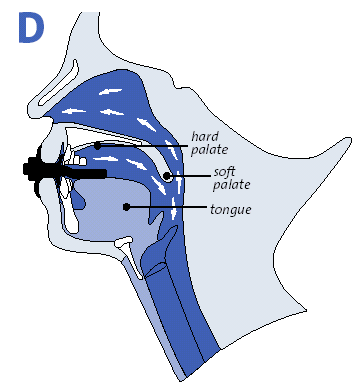
This is not just some yoga-new-age-mumbo-voodoo. There is a physiological rationale here. When you exhale too quickly, you throw off the CO2 balance in your blood. This is usually referred to as hyperventillation. Not healthy, to say the least. When your CO2 balance is off, your body stops functioning properly. This results in the fatigued I'm-so-tired-that-can't-even-find-the-strength-to-close-my-mouth look.

Aside from leaving the body in a panic-response mode, imbalances in blood pH can lead to immune deficiencies, and increase sensitivities to allergens and other air-borne pollutants. There are also several other points about the detriments of mouth-breathing, but the last one that I will bring up is that mouth breathers are obviously bad kissers.

Take running, for instance. Hmmm....now that I think of it, running may be a bad example of nose-breathing vs. mouth breathing since most people do not have to worry about breathing rythm. Also, I think that the general consensus among runners is that whatever works is good for you.

But that doesn't help to prove that nose breathing is better. Swimming: there's a sport where your breathing rythm affects performance. Try swimming while exhaling through the mouth, and then through the nose. You should find that you need to take fewer breaths/length when exhaling through the nose. Inhaling through the nose is a bit more difficult due to (proper) head position, so a combination of mouth-inhaling and nose-exhaling is probably best.

My bottom line here is that mouth breathing is just ugly, aside from being un-healthy. Especially when not exercising. Now, as a nose breather I know that nose-breathers can be equally loud. I am pretty sure that everyone has had that experience where they go from walking outdoors and sit down inside and then their nose starts running. If you don't have a bunch of tissues on you, you end up making sniffing sounds every couple of minutes. Believe it or not, but I find that this sound is much more tolerable than the slightly-audible grating of a mouth breather.

So, to all of the mouth breathers out there: there is hope for you. Admit you have a problem, and seek some rehabilitation.

Sunday, November 05, 2006

Throwing Swords for Dummies

Alright, admittedly this post is not in keeping with my previous ones, in that I am not going to be strictly commenting on internet tools for historians.

I'm not sure if I am the only movie-buff in the world who has noticed this, but sometimes it just seems this way. Have you ever watched a movie where the main character throws their sword? The most recent flick that I had seen it done in was "The Last Samurai" where Tom Cruise throws his sword, and it impales some guy like a spear.

Honestly, I can't help but start laughing whenever I see this. What strikes me as so funny is, first: the idea of using a sword as a spear sometimes seems to be a result of not actually having a spear in the prop department.

It kind of makes me think that our civilization does not actually remember what sword is for.

Second: (and I admit that I could be flat-out wrong on this one) Swords cannot be thrown like spears/javelins. Trust me, I have tried throwing any number of sword-like objects in the past (hey, we were all kids once!), and swords are just not balanced like spears, or knives.

Now, I have tried searching the web for this topic, but it seems to me that no one has actually posted on the real-world physics behind throwing swords. When performing a search on the google, the main hits returned were from a bunch of RPG-players trying to come up with the stats for "throwing swords", and sword manufacturers. There was one site that seemed as though the author had done some credible empirical research, until he made the following statement:

"...pointed out that there's a LOT more momentum behind a missile from a horse. Partly because of the extra height, partly because you've got that extra 30 mph to add to the missile. So, yes, a thrown big knife will do enough damage to be noticed."

Once again, demonstrating to me that scienticians (my definition: non-science people commenting on science) should take some physics.

So to end of this rant, I am going to start a list of movies that incorporate a scene where the hero throws a sword and impales his/her enemy, or cuts some object at the last possible moment to stop a chain of (possibly deadly) events from unfolding:

1) The Last Samurai; Tom Cruise impales the racist American colonel, from horseback.
2) Robin Hood: Prince of Thieves; Morgan Freeman throws his bizarre scimitar at the witch just before she stabs Robin in the back.
3) Any Movie with Schwarzenegger holding a sword; Conan, Red Sonja, the Conan Sequels, Predator (apparently this a machete, but hey!)
4) Monty Python's Quest for the Holy Grail: The Black Knight, anyone?
5) Gladiator: Russel Crowe gets one of the riders in the colosseum (who is on horseback)

If anyone would like to add to the list, please feel free.